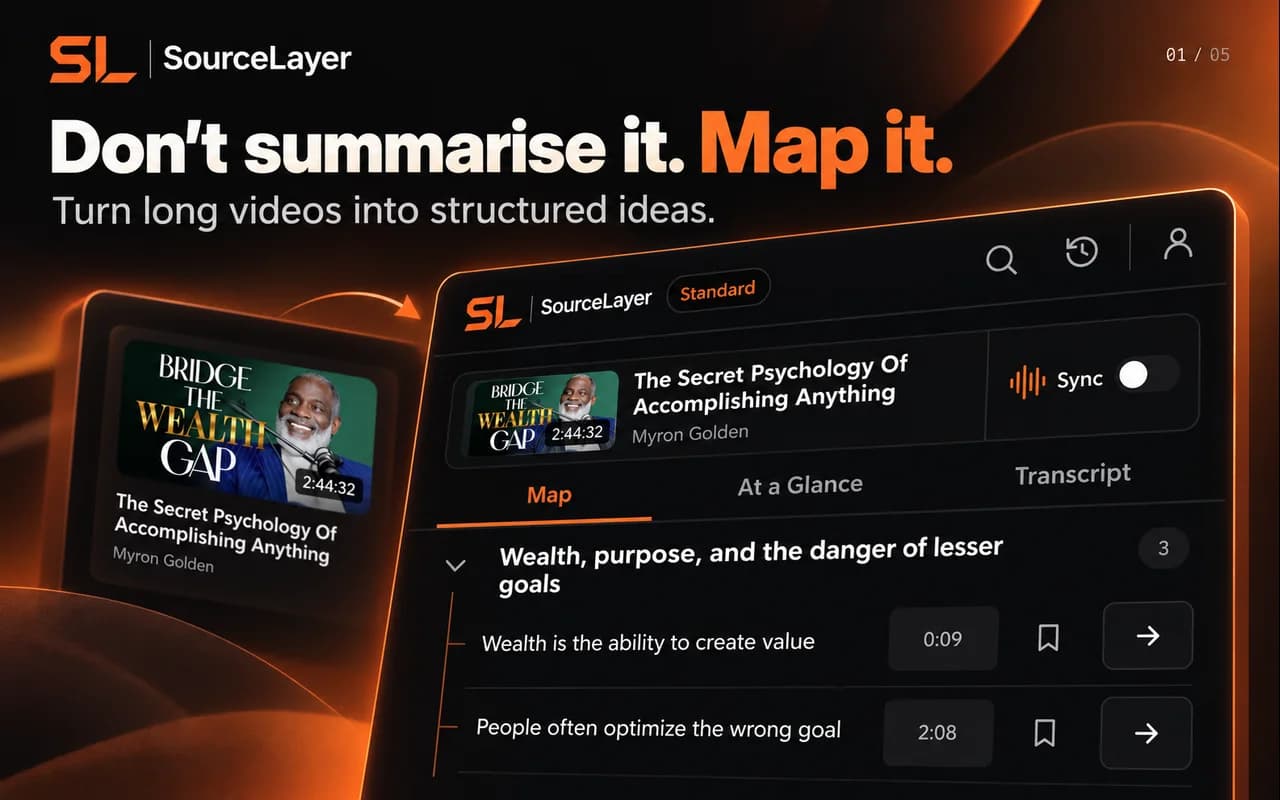
We make SourceLayer, so read this with that in mind. NoteGPT is a broad AI toolkit: video summaries, notes and one-click mind maps sit alongside file transcription, slides, AI writing and more. That breadth is its strength. People look for an alternative when they want a tool built around one job, or when they need to check each point of a video map against what was actually said.
A broad AI toolkit: video summaries, notes and one-click mind maps, plus file transcription, slides and writing tools
Pro: $9 a month billed yearly, or $9.99 monthly
Prices from each product’s own pricing page, checked 1 November 2026, except Eightify, whose prices we could not confirm. Prices and plans change; check each site before you buy. We make SourceLayer, so read this with that in mind.
01
Broad toolkit or focused tool?
A toolkit that does many things is good value if you use many of them. If you mostly work with YouTube, a focused tool can be simpler: fewer menus, a plan built around video hours, and features designed for that one job. Look at which NoteGPT tools you actually use each month before deciding.
02
Mind map or source-linked Map?
A mind map shows how a video’s ideas relate. The question for study and research is what happens when you click a node. Check whether it takes you to the passage that supports it, at the exact moment in the video, and whether the map follows along as the video plays. In SourceLayer, every idea opens its transcript passage and timestamp, and the Map syncs with playback. We have not verified how NoteGPT’s mind maps behave here, so test it on a video you know.
03
If you want a source-linked Map: SourceLayer
SourceLayer maps one long YouTube video into sections and ideas, links every idea to its transcript passage and timestamp, and follows the video as it plays. Saved Maps live in the Saved Library on Standard.
Pick one video of an hour or more that you already know well. Write down three things you remember from it: a definition, an example and a claim you might quote. Then, in NoteGPT and in each alternative you are considering, time how long it takes to find each one and to check the exact wording in the original video. The tool that gets you back to the right moment fastest, with the words you can verify, is the one that fits long videos. If you only ever needed the gist, the fastest summary wins instead.
09
SourceLayer’s limits
SourceLayer works with supported YouTube videos that have usable captions, in Chrome. Automatic captions can mishear names and technical terms, and a Map can miss context, so check the original video before relying on an idea. In the inspected extension implementation, video sync and timestamp seeking are limited to the first 90 minutes of a video. SourceLayer does not summarise web articles or PDFs.
10
Questions
What is a NoteGPT alternative for mind maps of YouTube videos?
SourceLayer builds a Map of sections and ideas for one long YouTube video. Each idea links to its transcript passage and exact timestamp, and the Map follows the video as it plays.
Is SourceLayer cheaper than NoteGPT?
No. NoteGPT Pro starts at $9 a month billed yearly. SourceLayer Standard is $13.99/month or $125.91/year in the US, and £10.99/month or £98.91/year in the UK, focused on long YouTube videos. SourceLayer Free includes 3 hours a month.
Is SourceLayer free?
Free includes 3 hours of video per month with no card. Standard is $13.99 per month or $125.91 per year in the US, and £10.99 per month or £98.91 per year in the UK and includes 30 hours per month plus the Saved Library.
Which browsers does SourceLayer support?
SourceLayer is a Chrome extension. It works beside supported YouTube videos that have usable captions.
See the Map and Saved Library
Product views from our published Chrome Web Store listing. Saving Maps and ideas is available on Standard.
Map: explore sections and ideas, then return to a timestamp.Saved Library on Standard: keep Maps and useful ideas for later.
Frozen marketing Map based on the captured public English caption track. Source: Physics Videos by Eugene Khutoryansky, Creative Commons Attribution (YouTube). Selected excerpts and editorial paraphrases; no affiliation or endorsement.
This example uses the current research demonstration. It illustrates Map navigation; it is not a transcript of the video.
Two slits turn individual impacts into an interference pattern
 Add SourceLayer to Chrome